

Short answer: most English-speaking doctors in Panama City work in the private sector — private hospitals, clinics and specialist offices. To find one, search a directory by specialty and language, confirm the doctor’s Panamanian license (idoneidad), check whether your insurance is accepted, and contact the office directly before your visit. In an emergency, call 911 or go to the nearest emergency room; do not wait for an online answer.
Moving to Panama, visiting on business or retiring here raises a simple but urgent question: who do I call when I need a doctor and I am not comfortable explaining my symptoms in Spanish? This guide explains how healthcare is organized in Panama City, where English is most commonly spoken, and the steps that save you time and money. CanalMarket Medical is a directory: we do not give medical advice, diagnose or recommend treatments. We help you find and contact providers.
Public and private healthcare in Panama: what changes for English speakers
Panama has two main systems. The public network is run by the Ministry of Health (MINSA) and the Social Security Fund (Caja de Seguro Social, CSS), which covers workers registered in Panama and their families. The private system includes private hospitals, clinics, laboratories and independent specialists, many of them concentrated in Panama City areas such as Punta Pacífica, Paitilla, San Francisco, Obarrio and Costa del Este.
For most expats and visitors, the private sector is where English is spoken most often. Many specialists in private practice trained or completed part of their studies abroad, and front-desk staff in larger private hospitals are used to international patients. That said, language skills vary from office to office, so always confirm before booking.
Step 1: Search by specialty, city and language
Start with what you actually need: a general practitioner (médico general), a pediatrician, a gynecologist, a dentist, a dermatologist or another specialist. Then filter by area of the city and by language.
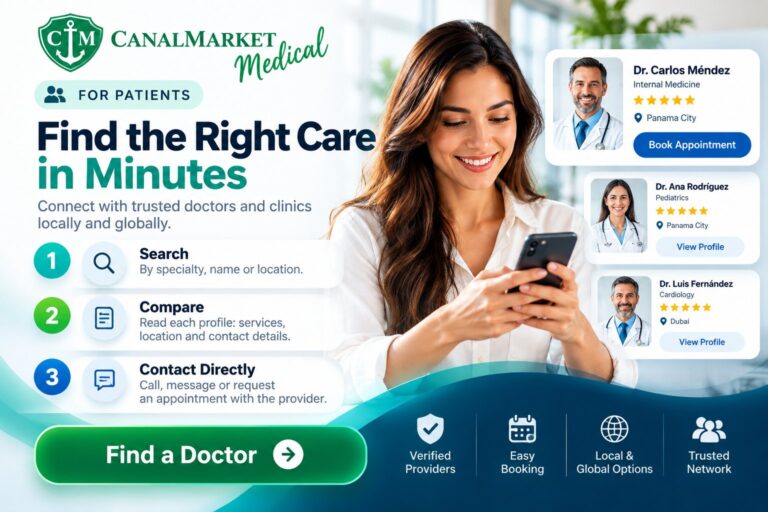
On CanalMarket Medical you can search doctors, clinics, pharmacies and medical centers in Panama, the UAE and the USA, or describe what you need to our AI assistant, Victoria (the chat button on every page), and get pointed to providers in the directory. Victoria answers questions about how the directory works; she does not give medical advice.
Step 2: Confirm the doctor’s license (idoneidad)
Every doctor who practices in Panama needs a professional license, known locally as idoneidad, issued through Panama’s health authorities. A legitimate office will give you the doctor’s full name, specialty and license number without hesitation. If something does not add up — no full name, no physical address, pressure to pay in advance in cash — look for another provider.
Specialists usually also list their board certifications and hospital affiliations. Write them down; they are useful if you ever need a referral or a second opinion.
Step 3: Check insurance, payment and prices before you go
Ask three questions when you call or write to the office:
- Do you accept my insurance? Local and international insurers work with different networks. Some offices bill the insurer directly; others ask you to pay and claim the refund yourself.
- How do I pay? Most private offices accept cards and cash; confirm in advance, especially for procedures.
- What will the consultation cost? Prices vary by specialty and location. Ask for the consultation fee in writing so there are no surprises.
We do not publish prices for providers: each office sets its own fees, so always confirm them directly.
Step 4: Prepare your visit so nothing gets lost in translation
Even with an English-speaking doctor, a little preparation helps:
- Bring a short written summary of your medical history, current medicines (with dose) and allergies, in English and, if possible, in Spanish.
- Bring copies of recent test results and your passport or Panamanian ID (cédula).
- Write your questions before the appointment.
- If you prefer, bring a bilingual friend or ask whether the clinic has an interpreter.
Step 5: Know what to do in an emergency
In Panama, dial 911 for emergencies. Save the address and phone number of the emergency room closest to your home or hotel before you need it. Online directories, chat assistants and email forms are not for emergencies.
Living in Panama or moving soon?
If you are relocating, healthcare is only one part of the plan. CanalMarket Group also helps with housing and short stays: see canalmarketproperty.com for real estate in Panama and canalmarketrental.com for vacation and short-term rentals. Medical travel to or from Dubai? CanalMarket Medical also lists providers in the UAE.
For doctors and clinics in Panama City
Do you speak English with your patients? International patients are actively looking for you. List your practice on CanalMarket Medical and show your specialty, languages, location and contact details, or see our plans to appear in more searches with a banner and marketing automations.
Frequently asked questions
Do doctors in Panama City speak English?
Many private-sector doctors and specialists in Panama City speak English, especially in larger private hospitals and clinics. It varies by office, so confirm before booking.
Can I see a private doctor in Panama without insurance?
Yes. Private offices see self-paying patients. Ask for the consultation fee and payment methods before the visit.
How do I check that a doctor is licensed in Panama?
Ask the office for the doctor’s full name and idoneidad (professional license) number and verify it with Panama’s health authorities if you have any doubt.
What number do I call for a medical emergency in Panama?
Dial 911 or go directly to the nearest emergency room.
Does CanalMarket Medical give medical advice?
No. CanalMarket Medical is a directory that helps patients find and contact providers. Always consult a qualified health professional.
Find a provider today: search the directory, ask Victoria, our AI assistant, or contact our team. Providers: list your practice.
CanalMarket Medical is a directory and does not provide medical advice, diagnosis or treatment. Each provider is responsible for the information in its profile.
Related articles